If your Google Ads campaigns are costing more than they should — or your ads rarely show up on page one — your Quality Score could be the culprit. Understanding what Google Ads Quality Score is, and how it affects every dollar you spend, is one of the most impactful things you can do as a small business advertiser.
In this guide, you’ll learn exactly what Quality Score is, why it has an outsized impact on your ad performance and budget, and — most importantly — the specific steps you can take right now to improve it.
What Is Google Ads Quality Score?
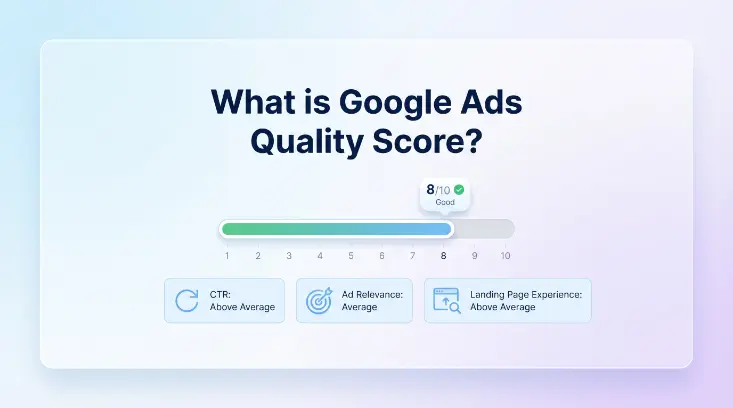
Google Ads Quality Score is a diagnostic metric — scored on a scale of 1 to 10 — that Google assigns to each of your keywords. It reflects how relevant and useful your ads, keywords, and landing pages are to the people who see them.
Free Google Ads Audit
Want Me to Review Your Account?
I will check your campaigns, tracking setup, and show you exactly where the opportunities are — completely free.
Think of it like a report card from Google. A score of 7–10 means you’re doing things right. A score of 1–3 is a red flag that something is misaligned — and it’s costing you.
Quality Score is built on three core components:
- Expected Click-Through Rate (CTR): How likely is someone to click your ad when it appears for that keyword?
- Ad Relevance: How closely does your ad copy match the intent behind the keyword?
- Landing Page Experience: When someone clicks your ad, does your landing page deliver on the promise? Is it fast, mobile-friendly, and relevant?
Each component is rated “Below Average,” “Average,” or “Above Average.” Your overall Quality Score is an aggregated reflection of all three.
Why Does Quality Score Matter for Your Campaigns?
Quality Score isn’t just a vanity metric. It directly affects two things every advertiser cares about: how much you pay per click and where your ads appear.
It Determines Your Ad Rank
Google doesn’t just give the top ad spot to whoever bids the most. Your Ad Rank is calculated using your bid multiplied by your Quality Score (along with a few other factors). This means a competitor with a lower bid but a higher Quality Score can outrank you — and pay less per click. That’s a big deal.
It Affects Your Cost-Per-Click (CPC)
Higher Quality Scores mean lower CPCs. Google rewards relevant, high-quality ads with discounted click costs. Conversely, a low Quality Score means you’re paying a premium just to show up. In our experience auditing hundreds of Google Ads accounts, businesses with consistently low Quality Scores (below 5) are often paying 30–50% more per click than they need to.
It Impacts Your Ad Visibility
Low scores can push your ads below the fold or prevent them from showing at all, especially if your bid isn’t competitive. Improving your Quality Score is essentially free advertising — you get better placement without increasing your budget.
How to Improve Your Google Ads Quality Score: Step-by-Step
Now for the part that actually moves the needle. Here are the specific actions you can take to raise your Quality Score across each of its three components.
Step 1: Tighten Your Ad Groups Around Single Themes
One of the most common structural mistakes we see is ad groups stuffed with dozens of loosely related keywords. The fix is to build tightly themed ad groups — ideally following the Single Keyword Ad Group (SKAG) or small-cluster approach.
For example, instead of one ad group called “Shoes” containing 40 keywords, create separate groups for “running shoes,” “women’s running shoes,” and “trail running shoes.” Each group gets its own tailored ad copy — which means higher ad relevance scores across the board.
Step 2: Write Ad Copy That Mirrors the Keyword Intent
Your ads need to speak directly to what the searcher is looking for. If someone searches “affordable plumber in London,” your headline should echo that intent — not just say “Plumbing Services.”
Use your target keyword in the first headline, the display URL path, and at least one description line. The closer the language match, the better your expected CTR and ad relevance — both key Quality Score factors.
Step 3: Optimize Your Landing Page for Relevance and Speed
Landing page experience is the most overlooked Quality Score factor — and often the hardest to fix quickly. Google evaluates whether your landing page is relevant to the ad and keyword, loads fast, and works well on mobile.
Quick wins: ensure your landing page headline matches your ad’s promise, include your target keyword naturally in the page copy, compress images for faster load times, and make sure your call-to-action is prominent on mobile screens. If your page loads in over 3 seconds, a significant portion of visitors — and your Quality Score — will suffer.
Step 4: Use Negative Keywords to Eliminate Irrelevant Traffic
Poor expected CTR often isn’t your ad’s fault — it’s that your ad is showing for searches it has no business appearing in. Regularly review your Search Terms report and add irrelevant queries as negative keywords.
When your ads only appear for highly relevant searches, your click-through rate improves — and so does your Quality Score. This is one of those compound wins: it saves budget and boosts performance at the same time.
Step 5: Test Ad Variations and Pause Low Performers
Run at least 2–3 ad variations per ad group and let data guide you. After a few weeks, pause the ads with lower CTRs. Consistently improving the CTR of your ads over time signals to Google that you’re a high-quality advertiser — which feeds positively into your Quality Score.
For more on writing high-performing ad copy, see our guide on Google Ads Responsive Search Ads Best Practices.
Common Quality Score Mistakes to Avoid
Even experienced advertisers fall into these traps. Watch out for:
- Sending all traffic to your homepage. Your homepage is rarely the most relevant destination. Create specific landing pages that match each ad group’s theme.
- Ignoring mobile experience. More than half of searches happen on mobile. A landing page that isn’t mobile-optimized will tank your landing page experience rating.
- Using broad match keywords without controls. Broad match keywords can trigger your ads for wildly irrelevant searches, destroying your CTR and Quality Score.
- Obsessing over the score itself instead of the components. Quality Score is a diagnostic, not a goal. Focus on improving ad relevance, CTR, and landing page experience — the score will follow.
- Setting campaigns and forgetting them. Quality Score can fluctuate over time. Build a habit of reviewing your keyword-level scores at least monthly.
Key Takeaways
Google Ads Quality Score isn’t just a number — it’s a window into how well your campaigns are set up. A high score means lower costs, better placement, and more efficient spend. A low score means you’re leaving money on the table every single day.
To summarize the key actions:
- Structure your ad groups around tight, single-theme keyword clusters
- Write ad copy that mirrors exactly what the searcher is looking for
- Build fast, mobile-friendly landing pages that match your ad’s promise
- Use negative keywords to protect your CTR from irrelevant searches
- Test ad variations consistently and cut what doesn’t perform