If your Google Ads Quality Score is low, you’re paying more per click than you need to and your ads may not even be showing. Understanding your Google Ads Quality Score is the single fastest lever most small business owners can pull to cut wasted ad spend and win more clicks. In this guide, you’ll learn exactly what Quality Score is, why it has a direct impact on your costs and ad rankings, and six proven strategies to improve it starting today.
What Is Google Ads Quality Score?
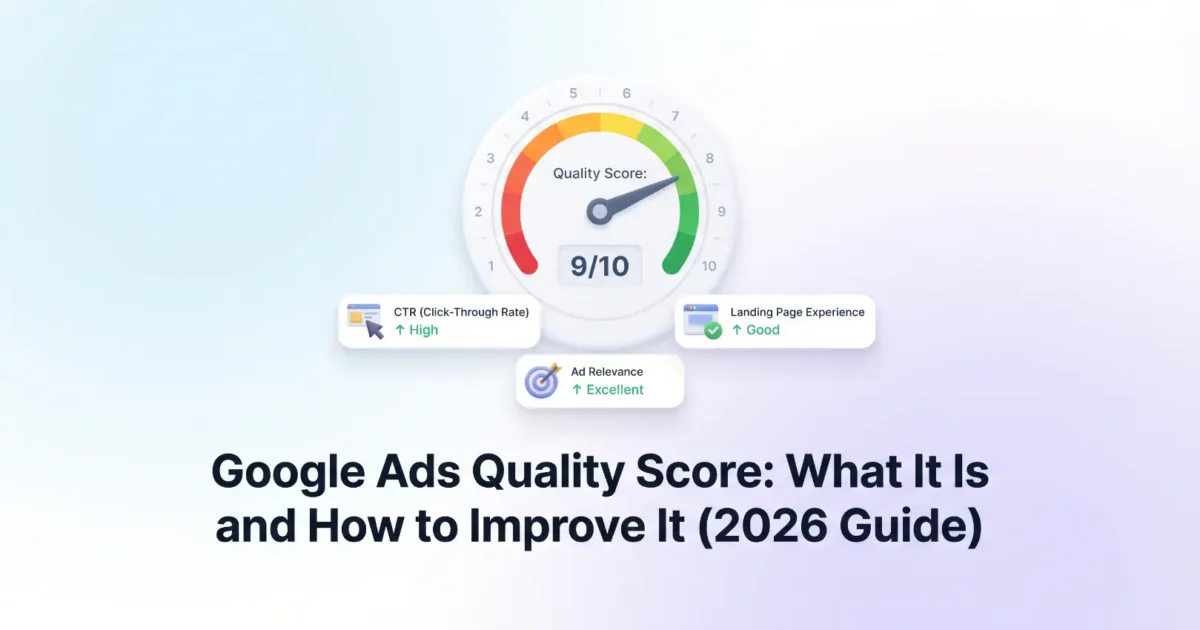
Google Ads Quality Score is a diagnostic metric scored from 1 to 10 that Google assigns to each of your keywords. Think of it as Google’s way of grading how relevant and useful your ads are to someone searching for that keyword.
A score of 10 means Google considers your keyword, ad copy, and landing page to be a near-perfect match for what searchers want. A score of 1 means there’s a significant mismatch somewhere in that chain.
Free Google Ads Audit
Want Me to Review Your Account?
I will check your campaigns, tracking setup, and show you exactly where the opportunities are — completely free.
Quality Score is calculated from three equally important components:
| ~40%Expected Click-Through Rate (CTR) | ~40%Landing Page Experience | ~20%Ad Relevance |
Expected CTR predicts how likely your ad is to get clicked when shown. Ad relevance measures how closely your ad copy matches the intent behind the keyword. Landing page experience reflects how relevant, transparent, and easy-to-navigate your landing page is for someone who clicked your ad.
Google evaluates each of these as “Above Average,” “Average,” or “Below Average” and the combination determines your 1–10 score.
Why Does Google Ads Quality Score Matter?
Here’s the part most business owners don’t realise: Quality Score directly affects how much you pay per click and where your ad appears on the page.
Google determines your ad’s position using a formula called Ad Rank. Ad Rank is your Max CPC bid multiplied by your Quality Score (along with a few other factors). This means a competitor with a higher Quality Score can outrank you even while bidding less money.
The financial impact is significant:
| Quality Score | CPC Impact vs Average | What It Means |
|---|---|---|
| 10 | Up to 50% cheaper | You pay far less for the same clicks |
| 7–9 | 16–30% cheaper | Strong competitive advantage |
| 5–6 | Baseline | You’re paying market rate |
| 3–4 | 25–67% more expensive | Burning budget for same placement |
| 1–2 | Up to 400% more expensive | Your ads may rarely show at all |
💡 Expert Insight
In our experience auditing hundreds of Google Ads accounts, the most common scenario we see is a business paying a $4–6 cost-per-click on keywords where a competitor with a tighter account structure is paying $2–3 for the exact same placement. That gap compounds fast we’ve seen accounts wasting $2,000+ per month simply due to poor Quality Scores.
How to Improve Your Google Ads Quality Score: 6 Proven Strategies
Improving your Quality Score isn’t about gaming Google it’s about genuinely making your ads more relevant to the people searching. Here’s how to do it, step by step.
Step 1: Tighten Your Ad Group Structure (SKAGs)
One of the most impactful changes you can make is moving from broad, bloated ad groups to tightly themed ones. The industry-proven approach is Single Keyword Ad Groups (SKAGs) or at minimum, tightly clustered theme groups.
Instead of one ad group called “Running Shoes” containing 50 keywords, create separate ad groups for “men’s trail running shoes,” “women’s cushioned running shoes,” and so on. This lets you write ad copy that speaks directly to each specific search dramatically improving your ad relevance score.
A quick rule: if you can’t use the keyword naturally in your headline, your ad group is probably too broad.
Step 2: Write Ads That Mirror the Searcher’s Intent
Your ad copy needs to reflect exactly what the person typed into Google. This is where many small business ads fall flat they promote the business instead of answering the searcher’s need.
If someone searches “emergency plumber London,” your headline should say something like “Emergency Plumber in London Available 24/7.” Not “Smith & Sons Plumbing Trusted Since 1998.”
Include your target keyword in Headline 1 whenever possible. Use Headline 2 for your value proposition, and Headline 3 for a call to action. Google rewards ads where the keyword appears in the copy it’s a direct signal of relevance.
Step 3: Optimise Your Landing Page for Relevance and Speed
Landing page experience accounts for a large chunk of your Quality Score, yet it’s the component most business owners ignore. Google’s bot visits your landing page and evaluates it for relevance, transparency, and usability.
Your landing page should contain the keyword prominently in the headline and body copy. The offer on the page must match the promise in the ad. If your ad says “50% off running shoes,” the landing page better show that discount immediately.
Page speed matters too. Use Google Page Speed Insights to check your load time. Pages that take over 3 seconds to load will hurt your landing page experience score, particularly on mobile.
Step 4: Improve Your Expected CTR With Better Hooks
Expected CTR is the biggest driver of Quality Score, and it’s based on your ad’s historical performance as well as Google’s prediction for how often it will get clicked. The best way to improve it? Write more compelling ads that earn more clicks.
Use numbers (“Save 40% Today”), questions (“Struggling With Back Pain?”), urgency (“Only 3 Spots Left This Month”), or social proof (“Trusted by 10,000+ Customers”) in your headlines. Run A/B tests across at least 3 ad variants per ad group.
Also make sure you’re using all available ad assets: sitelinks, callouts, structured snippets, and call assets. These expand your ad’s visual footprint and improve CTR significantly.
Step 5: Add Negative Keywords to Eliminate Irrelevant Traffic
Every time your ad shows for an irrelevant search and doesn’t get clicked, your expected CTR takes a hit. The fix? Aggressive negative keyword management.
Review your Search Terms report weekly, especially in the first 30 days of a campaign. Look for search queries that triggered your ads but clearly weren’t from your target customer and add those as negative keywords immediately.
For example, if you sell premium yoga mats, you’d want to negative out terms like “cheap,” “free,” “DIY,” or “how to make.” This keeps your ads showing only to high-intent, relevant searchers which protects and improves your CTR over time.
Step 6: Pause Low-Scoring Keywords and Rebuild
If a keyword has accumulated a Quality Score of 3 or below and it’s been running for 30+ days, it’s often faster to pause it, rebuild your ad group structure around it, and start fresh than to try to recover the score incrementally.
New keywords start with a neutral score and build quickly based on performance signals. A fresh, tightly structured campaign will outperform a patched-up old one in most cases.
💡 Expert Insight
When we audit accounts that have been running for 2+ years without restructuring, we almost always find “zombie keywords” terms with Quality Scores of 1–3 that have been burning budget for months. Pausing these alone can reduce wasted spend by 20–35% in the first month.
Common Quality Score Mistakes to Avoid
- Using one generic landing page for all ads. Every ad group ideally needs a landing page that speaks to that specific keyword and offer.
- Setting and forgetting campaigns. Quality Score evolves over time. An account that was healthy 6 months ago may have drifted significantly check your scores monthly.
- Obsessing over the number itself. Quality Score is a diagnostic, not an end goal. Focus on improving the three components; the score will follow.
- Ignoring mobile experience. A large share of searches happen on mobile. If your landing page isn’t mobile-optimised, your landing page experience score will suffer.
- Running too many keywords in one ad group. This is the number one structural mistake we see in small business accounts. More keywords per group almost always means less relevance, lower CTR, and worse scores.
Key Takeaways
Your Google Ads Quality Score is one of the most powerful levers in your entire campaign. Improve it and you pay less per click, rank higher, and get more value from every pound or dollar you spend on ads.
To recap the six strategies covered in this guide:
- Tighten your ad group structure
- Write intent-matched ad copy
- Optimise your landing pages for relevance and speed
- Improve your expected CTR with stronger hooks
- Build a robust negative keyword list
- Pause and rebuild keywords with persistently low scores
Even improving your average Quality Score from a 4 to a 6 across your account can translate to a 20–30% reduction in cost-per-click without increasing your budget by a single penny.
The best place to start? Look at your current Quality Scores in Google Ads (go to Keywords → Columns → Modify Columns → Quality Score) and identify your bottom 20% of keywords. That’s your action list for this week.