How to Improve Google Ads Quality Score: A Complete 2026 Guide for Small Business Owners
If your Google Ads are costing more than they should — or your ads rarely show up — your Quality Score could be the problem. Learning how to improve Google Ads Quality Score is one of the highest-leverage things you can do to get better results from your ad spend.
Quality Score isn’t just a vanity metric. It directly affects how much you pay per click and where your ads appear on the page. A low score means you’re paying a premium for worse placement. A high score means you’re paying less and winning more auctions.
In this guide, you’ll learn exactly what Quality Score is, why it matters, and — most importantly — the practical steps you can take right now to improve it.
Free Google Ads Audit
Want Me to Review Your Account?
I will check your campaigns, tracking setup, and show you exactly where the opportunities are — completely free.
What Is Google Ads Quality Score?
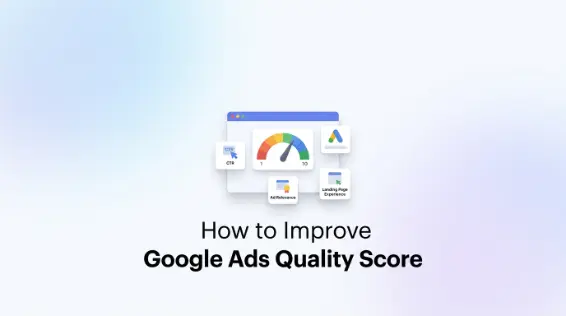
Quality Score is Google’s rating of the relevance and quality of your keywords, ads, and landing pages. It’s scored on a scale of 1 to 10 — with 10 being the best.
It’s made up of three components:
- Expected Click-Through Rate (CTR): How likely your ad is to get clicked compared to similar ads.
- Ad Relevance: How closely your ad matches the intent behind a search query.
- Landing Page Experience: How relevant, useful, and easy to navigate your landing page is for someone who clicked your ad.
Google combines these three signals to calculate your score. Each component is rated as “Below Average,” “Average,” or “Above Average.”
Why Does Quality Score Matter for Your Campaigns?
Quality Score has a direct impact on two things that matter most: how much you pay and where your ad shows up.
Google uses a formula called Ad Rank to determine ad placement. Your Ad Rank is your bid multiplied by your Quality Score (along with other factors). This means a competitor with a lower bid but a higher Quality Score can outrank you — and pay less per click.
Here’s what the research shows about cost differences by score:
- A Quality Score of 10 can reduce your cost-per-click by up to 50%.
- A Quality Score of 6 is the baseline — anything below that and you start paying a premium.
- A Quality Score of 1-2 can increase your CPC by as much as 400%.
In our experience auditing hundreds of small business Google Ads accounts, a low Quality Score is almost always the silent reason behind wasted budget. Fixing it is often the single fastest way to improve campaign ROI without spending a single extra dollar.
How to Improve Google Ads Quality Score: Step-by-Step Strategies
1. Tighten Your Ad Groups with Single Keyword Ad Groups (SKAGs) or Tight Themes
The most common mistake in Google Ads accounts is cramming too many unrelated keywords into a single ad group. When your ad group contains 50 different keywords, it’s nearly impossible to write an ad that’s highly relevant to all of them.
Instead, organize your campaigns so that each ad group contains a tight cluster of closely related keywords — ideally 5 to 10 max. This allows you to write ad copy that speaks directly to what each person searched for, boosting your ad relevance score significantly.
2. Write Ad Copy That Mirrors Your Keywords
Your ads need to speak directly to the intent behind the search query. If someone types “affordable plumber in Austin,” your headline should say something close to “Affordable Plumber in Austin” — not just “Plumbing Services.”
Practical tips for ad relevance:
- Include your primary keyword in at least one headline.
- Use dynamic keyword insertion (DKI) carefully to match search terms.
- Write descriptions that reinforce the benefit and match the user’s intent.
3. Improve Your Landing Page Experience
Your landing page is where Google checks if your ad’s promise is actually delivered. If someone clicks an ad about “custom wedding cakes” and lands on your homepage about general bakery services, Google considers that a poor experience — and so does the user.
To improve landing page experience:
- Make sure the landing page headline matches or closely reflects the ad headline.
- Ensure the page loads in under 3 seconds — page speed is a ranking signal.
- Make the page mobile-friendly — over 60% of Google searches happen on mobile.
- Use a clear, single call-to-action (CTA) that matches what the user is looking for.
4. Use Negative Keywords to Filter Irrelevant Traffic
Negative keywords are one of the most underutilized tools in Google Ads. When your ad shows for irrelevant searches and doesn’t get clicked, your expected CTR drops — which drags down your Quality Score.
Review your Search Terms report weekly. Add any searches that don’t match your intent as negative keywords. For example, if you sell premium handmade furniture, you’d want to exclude searches containing “cheap” or “IKEA.”
5. Test Multiple Ad Variations to Improve CTR
Expected CTR improves when people actually click your ads. The best way to lift CTR is to constantly test ad copy. Use Responsive Search Ads (RSAs) with at least 8–10 headline variations and 3–4 description options so Google can find the best-performing combinations.
Also use ad extensions (now called “assets”) like sitelinks, callouts, and structured snippets. These expand your ad’s real estate and give users more reasons to click — both of which increase your CTR.
For a deeper look at structuring your campaigns for maximum efficiency, see our guide on Google Ads campaign structure for small businesses.
Common Mistakes That Tank Your Quality Score
Even experienced advertisers make these errors. Watch out for:
- Using broad match keywords without controls. Broad match can trigger your ads for wildly irrelevant searches. If you’re going to use broad match, pair it with smart bidding and a solid negative keyword list.
- Sending all traffic to the homepage. Your homepage is almost never the most relevant landing page for a specific ad. Build dedicated landing pages for each campaign or product category.
- Ignoring the Search Terms report. This report tells you exactly what people typed before clicking your ad. If you’re not reviewing it regularly, you’re likely paying for irrelevant clicks.
- Never testing new ad copy. Running the same ads for months without testing is a missed opportunity to improve CTR and relevance.
- Slow or cluttered landing pages. Page speed and UX are critical. Use Google’s PageSpeed Insights tool to identify and fix technical issues dragging down your landing page experience score.
Final Thoughts
Improving your Google Ads Quality Score isn’t about gaming the system — it’s about doing the fundamentals well. When your keywords, ads, and landing pages all work together to deliver exactly what the searcher is looking for, Google rewards you with lower costs and better placement.
Here’s a quick recap of the steps:
- Organize ad groups around tight keyword themes.
- Write ad copy that directly mirrors search intent.
- Build relevant, fast, mobile-friendly landing pages.
- Add negative keywords regularly to filter bad traffic.
- Continuously test ad variations to lift CTR.
Even small improvements in Quality Score can have a compounding effect over time — saving you money on every click while helping your ads reach more of the right people.